Log On, Knock Down: The Digital Invasion of Blood Bowl—and Why the Dice Are Fine
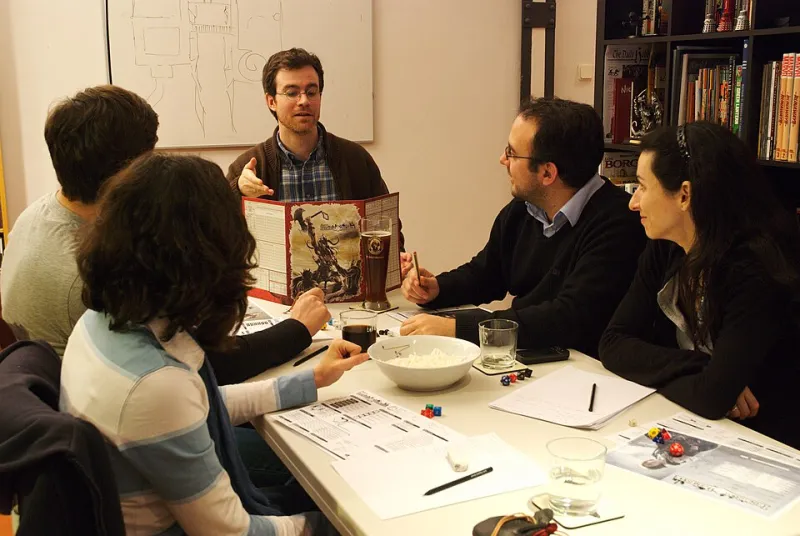
Photo: Diacritica, CC BY-SA 3.0, via Wikimedia Commons
Ten years ago, if you wanted to play Blood Bowl in America, you had exactly one option: find a game store, find three other weirdos, and pray nobody moved to a different state. Today? You can join a Discord league with coaches in six states, play your round on Tuesday night in your pajamas, and watch the national championship streamed with commentary from a basement in Ohio. The game has never been more accessible. The game has also, according to a vocal contingent, never been in more danger.
Both things can be true. Let's argue about it.
The Case for the Digital Pitch
The strongest argument for online play is brutal in its simplicity: more games is more better. League management tools—the various roster trackers, scheduling bots, and Discord servers that automate what commissioners once did with spiral notebooks—have collapsed the friction that killed most local leagues. Coaches who can't commit to every Thursday at the shop can still play a full season. Parents, shift workers, folks in rural Montana: the digital league found them all.
And streaming has changed tournament culture, too. Finals matches with commentary do something print coverage never could—they teach. A newer coach can watch a top-table cage dance, hear the reasoning explained in real time, and bring that knowledge to their next event. Several US tournament organizers told us their new-player attendance ticked up after they started streaming top tables. The stream is a recruiting poster that plays itself.
The Case Against (or So They Say)
The skeptics aren't Luddites. Their worry is subtler: that every hour spent on a digital pitch is an hour not spent at a physical table, and physical tables are where the culture lives. The trash talk. the post-game food run. The apologetic handshake after your troll decides to eat his own teammate. You cannot replicate that through a webcam, and the folks who fell in love with this game fell in love with that.
There's also a competitive integrity gripe. Online play, some argue, produces a different kind of coach—one optimized for turn timers and spreadsheet management rather than reading a human across the table. Whether that's a real problem or just old-coach grumbling is very much a matter of perspective.
The Commissioners Weigh In
We asked league commissioners on both sides of the divide, and the honest ones gave roughly the same answer: it's not either/or. The healthiest US scenes we looked at use digital tools as the scheduling and admin layer while keeping games at physical tables whenever possible. Discord handles the roster tracking and the memes; the game store handles the dice and the drama.
One commissioner in the Pacific Northwest put it plainly: 'The online league is the front door. The table is the house. Stop confusing the door for the house.'
Verdict: The Pitch Is Bigger Now
Here's our editorial take, for what it's worth: the digital wave isn't killing tabletop Blood Bowl. It's feeding it. Every online league graduate eventually wants to smell the turf, and every streamed tournament funnels curious lurkers toward their nearest game store. The scenes that are struggling are the ones that treated online play as competition instead of pipeline.
The dice don't care where they're rolled. But the community—the real one, the one that argues about fouling rules over nachos—that happens face to face. Use the internet to find the table. Then get to the table.