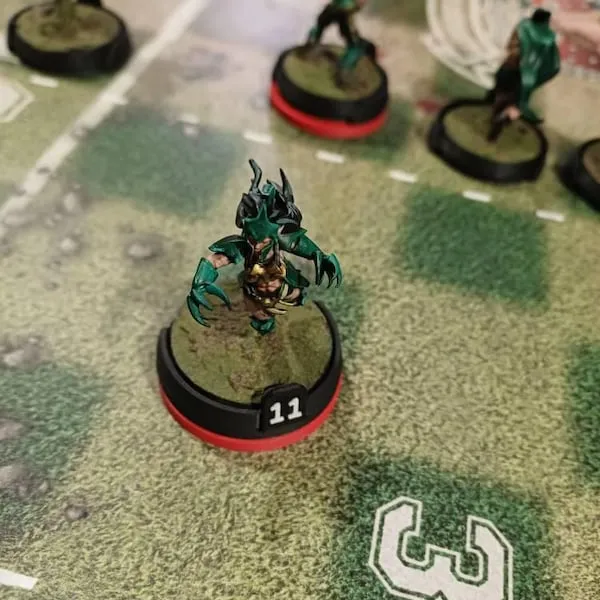
Hidden in Plain Sight: Why Your Third-String Thrower Is the Sneakiest Weapon in Your Entire Roster
Let's talk about the player nobody puts on their team jersey. The guy who doesn't get the pregame hype. The one warming the bench so hard he's practically part of the furniture. Your third-string thrower.
Yeah. That guy.
Here's the uncomfortable truth that's been quietly reshaping how top US coaches build rosters heading into the 2024-2025 competitive season: the teams consistently making deep tournament runs aren't just stacked at the top. They're functional three positions deep at the spots that matter most. And nothing matters more — or gets ignored more catastrophically — than ball-handling depth.
The Myth of the Untouchable Star
Every Blood Bowl coach has lived this nightmare. Your premium thrower, the one you've spent three seasons developing into an absolute machine, eats a block in turn two and suddenly you're staring at a replacement who last touched the ball during a practice warm-up. The crowd goes quiet. Your opponent grins. You start calculating whether you can grind out a 1-0 win with no passing game whatsoever.
Spoiler: you usually can't.
The instinct most coaches have is to pour resources into protecting the star — stack your line, buy bodyguard skills, play conservatively. Reasonable. Also, completely predictable. Your opponent has scouted your roster. They know your backup situation is ugly. So they go hunting.
What changes when you have a legitimate third-string option? Everything. Suddenly, the calculus your opponent ran before the game is wrong. The aggressive blitz strategy designed to decapitate your passing game becomes a gamble rather than a sure thing. You've introduced doubt, and doubt is worth more gold pieces than most coaches realize.
What "Credible" Actually Means
Let's be precise here, because there's a difference between warm body with hands and actual backup competency. A credible backup thrower doesn't need to replicate your star. They need to be good enough that your opponent can't just switch off their defensive game plan the second your first-stringer goes down.
At minimum, that means a player who can execute a short pass reliably, hold possession under pressure, and not immediately become a liability every time the ball lands in their hands. Skills investment matters here — even a single relevant skill on a backup changes how threatening they look on paper, which changes how your opponent allocates attention.
In practical terms, coaches who've cracked this formula in recent US regional tournaments have talked about what they call the "credibility threshold" — the point at which an opponent can no longer safely ignore your depth. You don't need your backup to be elite. You need them to be scary enough that writing them off costs something.
Tournament Case Studies: Depth Paying Dividends
At a Midwest regional event earlier this year, a Human team coach made a deliberate choice during roster construction that raised some eyebrows in the pre-tournament chatter. He'd invested in developing what looked, on paper, like an overstocked backfield — two capable throwers plus a third player with just enough skill investment to be dangerous in a pinch.
Opponents in his bracket prepared for his primary ball handler. The backup was a known quantity. Nobody really accounted for option three.
When his starter took a nasty hit in the semifinal, rather than turtling into a grind, this coach flipped to a modified passing scheme using his third option. Opponents hadn't game-planned for that player's specific skill set. The adjustment caught everyone off guard, and he walked into the final with momentum his opponent couldn't reverse.
A similar story played out at a Southeast tournament circuit event, where a Skaven coach — a race already known for chaotic, high-variance play — specifically built roster depth at the ball-carrier position to account for the team's naturally high casualty rate. The strategy wasn't about any single player being exceptional. It was about never having a moment where the passing game simply ceased to exist. The team finished the event with a record that defied their injury count because the offense never fully collapsed, no matter how many hits they absorbed.
The Opponent-Preparation Problem
Here's an angle that doesn't get discussed enough: backup depth doesn't just protect you from bad dice. It actively complicates your opponent's preparation.
Serious tournament coaches study rosters before they play. They identify the key threats, map out how to neutralize them, and walk into the match with a plan. That plan almost always assumes your depth situation is thin, because most rosters have thin depth. It's the norm.
When your roster breaks that norm — when your third-string thrower is actually a functional threat — you're forcing opponents to split their preparation attention. Do they account for your backup? Do they game-plan for a scenario where your primary ball handler is off the pitch by turn four? That preparation overhead is a real cost, and it accumulates over a long tournament weekend when coaches are already mentally taxed.
The teams that have quietly weaponized this in 2024-2025 aren't necessarily the ones with the flashiest star players. They're the ones whose opponents keep walking away saying, I just couldn't find the kill shot.
Building the Depth Without Breaking the Bank
The obvious objection: roster spots cost money, and gold pieces spent on a third-string thrower are gold pieces not spent on your frontline. Fair. This isn't an argument for reckless spending.
The practical approach most successful coaches have landed on is incremental investment. Your third-string option doesn't need to arrive fully formed. A baseline player with a clear development path — one or two affordable skills that specifically address their backup role — is enough to cross the credibility threshold. You're not building a second star. You're building a functional contingency that makes your opponent's life harder.
The timing matters too. Mid-season roster construction, when you have a clearer picture of your injury patterns and your opponents' tendencies, is often the right window to shore up that depth position rather than blowing your budget on it in week one.
The Takeaway Nobody Wants to Hear
Roster construction in competitive Blood Bowl has always been about managing variance. But the coaches finding edges in 2024-2025 aren't just managing their own variance — they're creating variance for their opponents by refusing to have an obvious weak point.
Your third-string thrower is, in the right context, a strategic asset disguised as a bench warmer. The moment your opponent stops being able to safely ignore them, you've already won a small but real piece of the mental game.
Now go find that guy gathering dust at the bottom of your depth chart. Dust him off. Maybe invest a skill or two. Your next opponent is going to have a very bad time trying to figure out what to do about him.