Throw Out the Playbook: How America's Weirdest Rosters Are Winning Right Now
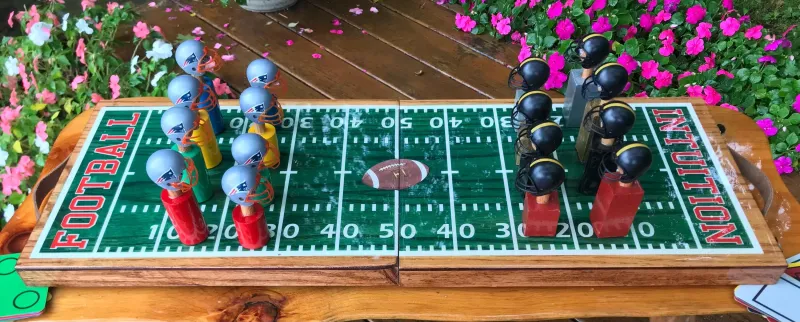
Photo: tabletop fantasy football strategy unconventional game pieces board game tournament, via i.etsystatic.com
There's a moment at every major US Blood Bowl tournament — somewhere around the second round, usually — when a veteran coach glances across the table at their opponent's roster sheet and does a visible double-take. Not the polite kind. The kind where their eyebrows briefly attempt to leave their forehead entirely.
"Wait. You're running how many Goblins?"
And then, four turns later, they're watching those Goblins do something statistically improbable and tactically baffling, and they're losing, and the existential crisis has officially begun.
Welcome to the new American Blood Bowl scene, where the cookie-cutter meta builds are starting to get cooked — sometimes literally — by coaches who decided that conventional wisdom was a trap and went their own direction entirely.
The Predictability Problem
Here's the uncomfortable truth that's slowly dawning on the competitive community: the US Blood Bowl scene has gotten good. Like, genuinely, deeply good. Coaches at regional level are increasingly well-versed in standard team construction theory. They know the optimal skill progressions. They know which positionals to prioritize. They've read the same strategy threads, watched the same YouTube breakdowns, and arrived at remarkably similar conclusions about how rosters should look.
And that's exactly the problem.
When everyone builds the same way, everyone defends the same way. A highly optimized, perfectly conventional roster is, in a mature competitive scene, also a highly readable one. Your opponent has seen your build before. They know your win conditions. They know what you're trying to do before you do it.
Conventional wisdom is most dangerous when it becomes universal.
A growing cohort of US coaches has started exploiting this. Not by being reckless — these aren't casual players stumbling into wins — but by being deliberately unpredictable in ways that force opponents to problem-solve on the fly, under pressure, against a game plan they never prepared for.
The Pacific Northwest Experiment
One of the most talked-about examples from recent regional play came out of the Pacific Northwest, where a Human coach showed up to a sixteen-person regional with a roster built almost entirely around Linemen and a single, heavily-skilled Thrower — deliberately forgoing the Blitzer-heavy core that virtually every competitive Human build leans on.
The conventional read on this? Suicide. Human Blitzers are widely considered some of the best value positionals in the game. Skipping them to stack Linemen looked like a beginner's mistake.
Except the coach had a plan. The Thrower was loaded with skills designed for a short-passing game that essentially weaponized the Linemen as receivers in unexpected positions. Opponents spent their first few turns trying to locate the threat they expected — the Blitzer cage, the standard Human grind — and kept getting caught by a ball movement scheme that didn't exist in their mental preparation library.
He went 3-1-1 and finished second. His one loss came against another unconventional build, which, if you're looking for a theme, is not a coincidence.
Breaking the Bash Formula in the Midwest
Out of a Chicago-area league that feeds into regional play, a Dwarf coach has been turning heads by running what his opponents have started calling "the Speed Dwarf" — a deeply heretical concept in a faction whose identity is basically built around being slow, grinding, and impossible to move.
His roster carries an unusual emphasis on player mobility upgrades and a positional spread designed to cover more of the pitch than Dwarf teams traditionally bother with. The result is a team that plays nothing like a Dwarf team is supposed to play. It doesn't park and grind. It moves. It creates angles. It makes opponents who prepared for a traditional attrition game suddenly feel like they're playing against a completely different faction.
"Everyone comes in knowing how to play against Dwarfs," he explained at a post-tournament roundtable. "They know the pace, they know the patience game, they know how to wait me out. So I just... stopped playing that game. They prepped for chess and I brought checkers."
He's taken two regional top-fours with this build. The results suggest the heresy is working.
What the Rebels Actually Have in Common
Look across enough of these unconventional success stories and a few consistent threads emerge — which is useful, because it means this isn't just variance. These coaches aren't getting lucky with weird builds. They're applying genuine principles, just from an unusual angle.
They understand the meta deeply before they break it. Every one of these coaches can tell you exactly why the conventional builds are conventional. They're not ignoring standard theory out of ignorance — they're inverting it deliberately. You can't exploit predictability if you don't know what predictable looks like.
Their weird choices solve a specific problem. The unconventional element isn't random. The Human coach skipped Blitzers because he wanted to neutralize opponent defensive schemes built around containing Blitzers. The Dwarf coach added mobility because he wanted to disrupt opponent patience strategies. The weirdness is purposeful.
They practice the unconventional build extensively. This might sound obvious, but it's worth stating: showing up to a tournament with a roster you've never played before is not a strategy, it's a disaster. The coaches succeeding with unusual builds have logged serious table time learning how to make the weird thing actually work under pressure.
They pick their spots. Not every tournament is the right venue for an experimental build. Regional events with field diversity are often better testing grounds than national-level events where the field is narrower and the conventional builds are maximally optimized.
Is This a Movement or a Moment?
Fair question. Is this actually a trend, or are we pattern-matching on a handful of interesting results?
Based on conversations across the US competitive community, it feels like something real is developing. As the scene matures and the average player quality rises, the returns on purely optimized conventional builds are diminishing. The edge that comes from playing the "right" roster is shrinking because everyone is playing the right roster.
In that environment, the coach who shows up with something genuinely unexpected — and has done the work to make it dangerous — has a structural advantage that's independent of dice luck or raw skill level. They're operating outside the preparation window of their opponents.
That's not a fluke. That's a competitive edge.
The pitch is getting crowded with coaches who've read the same playbook. The ones winning championships right now might just be the ones who wrote their own.